0208 993 4500
 dental@schoolofdentalnursing.com
 +44 7856 755880
Every dental X-ray is a trade-off. It gives the dentist information they cannot get any other way, but it also exposes the patient to a small dose of radiation. The skill is not just taking the picture. It is taking the right picture, safely, the first time.
That is exactly what dental nurse radiography training teaches. If you are a registered dental nurse looking for your next step, the NEBDN Certificate in Dental Radiography can expand what you are trusted to do, make you more valuable to your practice, and open doors to more senior roles. This guide explains how, starting from the basics.
First, What Is a Dental X-Ray?
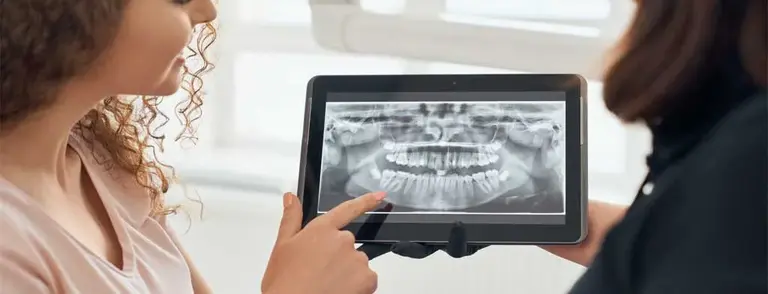
A dental X-ray, also called a radiograph, is an image made by passing a small amount of radiation through the teeth and jaw. Dense structures like enamel and bone block more radiation and show up lighter; softer areas let more through and show up darker. That contrast lets a dentist spot decay between teeth, infections at the root, bone loss and problems hidden below the gum.
Because radiation carries a small risk, its use in UK healthcare is tightly regulated. The two key sets of rules are the Ionising Radiations Regulations 2017 (IRR17), which focus on protecting staff and the public, and the Ionising Radiation (Medical Exposure) Regulations 2017 (IR(ME)R), which focus on protecting patients.
Behind both sits a simple principle called ALARP: keeping radiation doses “as low as reasonably practicable”. Think of it like sun cream. You do not avoid the sun entirely, but you limit exposure to what you actually need.
What a Dental Nurse Does in Radiography
Without the certificate, dental nurses already support radiography by preparing the patient and helping with infection control around the equipment. With the certificate, your role grows significantly. According to NEBDN, qualified learners can act as an IR(ME)R operator, taking intra-oral and extra-oral radiographs safely under a dentist’s prescription.
In plain terms:
- The dentist decides whether an X-ray is needed and what type. This is called justification.
- You carry it out: positioning the patient and equipment, taking the image safely and checking its quality.
- You help manage the images so they are stored correctly and available for diagnosis and treatment planning.
Intra-oral X-rays are taken with a sensor or film inside the mouth. Extra-oral X-rays, such as a panoramic view of the whole jaw, are taken from outside.
Why the First Image Matters Most
Here is where good thinking makes a real difference. Use inversion and ask: “What would make me need to retake this X-ray?” Common answers include the patient moving, the sensor sitting at the wrong angle, or part of the tooth being cut off the image.
Now apply second-order thinking. A retake is not just a delay. It means a second dose of radiation for the patient, more chair time, and a little less trust in the process. That is why careful preparation is so important:
- Explain the procedure so the patient knows to stay still.
- Check positioning twice before exposure.
- Review the image straight away and flag any quality issue to the dentist.
Getting it right first time is the most practical expression of ALARP, and it is a habit that marks out an excellent radiography nurse.
Inside the NEBDN Certificate in Dental Radiography
Who it is for
The course is designed for registered dental nurses who want to take on more responsibility in patient care. You will need to be working in a dental setting where you can gain hands-on radiography experience under supervision. If you are not yet qualified, your first step is the NEBDN Level 3 Dental Nursing course.
What you will learn
Topics include the principles of how X-rays are produced, radiation protection and the law, safe techniques for taking intra-oral and extra-oral radiographs, assessing image quality, and handling and storing images correctly.
How you are assessed
According to NEBDN’s Dental Radiography qualification page, you need to complete two things:
- A Record of Competence, which is work-based evidence from your practice. It includes practical competence assessment sheets, case studies and supplementary outcomes.
- A 90-minute written exam, made up of multiple choice and extended matching questions, held in March and September.
How the Certificate Boosts Your Career
- A wider scope of practice. Your scope of practice is the list of tasks you are trained, competent and allowed to do. This certificate adds X-ray work to it, like adding a new category to a driving licence.
- More value to your practice. A dental nurse who can take radiographs frees up the dentist’s time and keeps appointments running smoothly.
- Routes to progression. NEBDN highlights roles such as lead dental nurse, and radiography experience can also support a future move into dental hygiene or therapy, which require further degree-level training.
- Greater confidence and job satisfaction. You play a direct part in how patients are diagnosed and treated.
How to Succeed on the Course
The Pareto Principle says roughly 20% of your effort drives 80% of your results. In radiography, that 20% is radiation protection, correct positioning and image quality. Master these, and the rest of the syllabus falls into place.
- Log your Record of Competence evidence as you go, not in a rush at the end.
- Ask your supervising dentist for feedback on every image in the early weeks.
- Practise exam questions little and often, especially on regulations and ALARP.
- Use your tutor and fellow learners. Explaining a concept to someone else is one of the fastest ways to learn it.
Ready to take the next step? Find out more about our NEBDN Certificate in Dental Radiography course.
Quick-action summary
- The certificate is for registered dental nurses who want to take radiographs as an IR(ME)R operator.
- Radiation use is governed by IRR17 and IR(ME)R, built around keeping doses as low as reasonably practicable.
- Assessment is a work-based Record of Competence plus a 90-minute written exam.
- Getting a usable image first time is the most important skill you can build.
Take the Next Step in Your Career
Every X-ray you take safely and accurately helps a dentist make a better decision for a patient. That is real responsibility, and real professional growth.
Ready to step into your potential and add radiography to your skill set? Apply Now – School of Dental Nursing Application FormHave questions about entry requirements or how the course fits around your work? Speak with an experienced advisor.Book a Call with an Advisor