0208 993 4500
 dental@schoolofdentalnursing.com
 +44 7856 755880

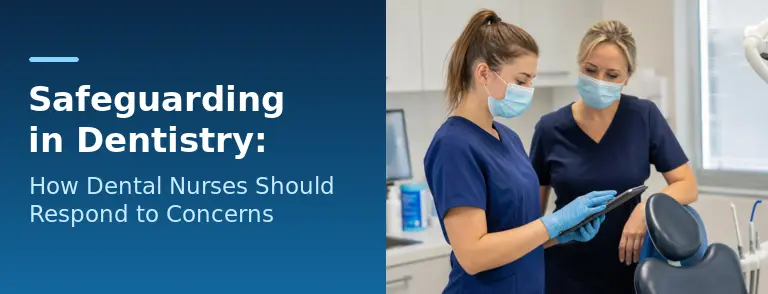
Here’s a truth that surprises most new dental nurses: *the most important safeguarding skill isn’t spotting abuse. It’s knowing what not to do once you notice something.* Safeguarding in dentistry doesn’t ask you to be a detective, a judge or a rescuer. It asks you to notice, listen, write down the facts and pass them to the right person, calmly and quickly. Do those four things well and you may change the course of someone’s life without ever knowing it.
This guide is written for complete beginners. No prior knowledge needed. By the end, you’ll know exactly how to respond to a concern, what to write, who to tell, and where your role stops.
What Safeguarding in Dentistry Actually Means
Safeguarding means protecting people’s health, wellbeing and safety, especially people who may struggle to protect themselves. In a dental practice, that includes:
- Children and young people
- Adults at risk, meaning adults who may be more vulnerable because of illness, disability, age, dependence on others or difficulty communicating
Think of safeguarding like a smoke alarm. A smoke alarm doesn’t put out the fire or work out what caused it. Its job is to make a clear signal early, so the people trained to respond can act. That’s your role too.
It’s also a professional duty, not an optional extra. The General Dental Council Standards for the Dental Team say you must raise any concerns about the possible abuse or neglect of children or vulnerable adults, know who to contact for advice, and follow local procedures.
Why the Dental Chair Sees What Others Miss
Dental teams often see patients regularly, sometimes for years. You notice when a confident child suddenly becomes withdrawn, when an older patient seems frightened of the person who brings them, or when a mouth shows signs of long-term neglect.
One example matters especially. Many practices now say a child “was not brought” to an appointment rather than “did not attend.” The British Dental Association’s safeguarding guidance explains that this change in wording helps the team see the situation from the child’s point of view, because a child can’t bring themselves to the dentist. Repeated missed appointments can be an early sign of neglect.
The Four-Step Response Every Dental Nurse Should Know
When something feels wrong, use this simple sequence:
- Safety first. Is anyone in immediate danger?
- Let the person speak in their own words.
- Write down the facts as soon as you can.
- Tell your practice’s safeguarding lead (or the named alternative) promptly.
In an emergency the order may change, but the principle never does: get accurate information to the right person, fast.
If Someone Is in Immediate Danger
If you believe a patient or anyone else faces immediate risk, put safety first. Involve a senior person straight away and follow your practice’s emergency procedure, which may mean calling 999. Don’t wait to “be sure” before acting. You aren’t expected to understand the full background, only to make sure the right people know right now.
If a Patient Tells You Something Worrying
This is called a disclosure: when someone tells you about harm they’ve experienced or are at risk of. Here’s how to respond:
- Stay calm and give them your full attention.
- Let them talk without interrupting or pushing for details.
- Don’t ask leading questions. “Did your dad do that?” suggests an answer. “Can you tell me more?” doesn’t.
- Never promise to keep it secret.
- Write down their exact words as soon as possible, in quotation marks.
A simple script you can use:
“Thank you for telling me. I’m really glad you did. I can’t keep this just between us, because I need to make sure you’re safe, but I’ll only tell the person whose job it is to help.”
Why You Should Never Promise Secrecy
This is where second-order thinking, asking “and then what?”, protects everyone. Promising secrecy feels kind in the moment. But then what? You either break that promise and damage the person’s trust, or you keep it and leave them at risk. Honesty from the start is kinder in the long run.
Separate What You Saw From What You Think
Here is the single most valuable habit in safeguarding: keep observations and interpretations apart.
An observation is something you directly saw or heard. An interpretation is the meaning your mind adds. Your brain jumps from one to the other in a split second, so you have to catch it on purpose.
|
Observation (record this) |
Interpretation (don’t record this as fact) |
|
The patient looked down and said, “I don’t want to go home.” |
The parent is abusive. |
|
Bruising was visible on the patient’s upper arm. |
Someone has been hurting them. |
|
The child has missed three appointments in six months. |
The family doesn’t care. |
Think of it as signal versus noise. The observation is the signal. Your guess about what it means is noise, however strong the feeling. A single sign can have many explanations, and deciding what it means isn’t your job. Passing on the clean signal is.
How to Write a Safeguarding Record
A good record lets someone else understand exactly what happened without having been there. Use your practice’s approved system, write it promptly, and never alter the original in a way that hides what was written. Include:
- Date, time and location
- Who was present (names or roles)
- The person’s exact words, in quotation marks
- What you directly saw or heard
- Any questions you asked and the answers given
- Any immediate action taken to keep someone safe
- Who you told, when, and what advice you received
- Any agreed follow-up
Keep your language factual and neutral. Leave out guesses, diagnoses, blame and emotional descriptions. And don’t delay reporting while you try to write the perfect account. A prompt, clear record beats a late, polished one.
Who Does What: Safeguarding in Dentistry as a Team Effort
Safeguarding is a team responsibility, but each role is different.
|
Role |
What they do |
|
Dental nurse |
Notice, listen, record and raise concerns promptly, staying within the limits of the role |
|
Wider dental team |
Keep the environment safe, share information appropriately and support the agreed response |
|
Safeguarding lead |
Advise colleagues, coordinate the practice’s response and make referrals through local procedures |
The Care Quality Commission, which inspects dental practices in England, expects every practice to have a designated safeguarding lead who supports colleagues. Before you treat a single patient, find out who that person is.
What Dental Nurses Should Never Do
A powerful thinking tool called inversion asks: “How could I make this go badly?” Applied to safeguarding, the answers are clear. You could make things worse by:
- Investigating the concern yourself
- Confronting the person you suspect
- Pressuring the patient for more information than they want to share
- Promising secrecy, or that “everything will be fine”
- Deciding the concern is too small to report
- Trying to mediate between the people involved
Avoid these and you’ve already avoided most of the ways safeguarding goes wrong. Raising a concern is not making an accusation. It’s a professional step that lets trained people look at the information properly.
If you feel your concern hasn’t been acted on, follow your practice’s escalation process and keep a factual note of what you reported and when.
Confidentiality: Why It Isn’t an Absolute Promise
Confidentiality means keeping patient information private and only sharing it through proper professional channels. It matters enormously, but it has limits. When someone may be at risk of harm, a request for secrecy doesn’t override the need to follow safeguarding procedures.
Consent, mental capacity and information sharing can be legally complex. You’re not expected to solve those questions alone. When in doubt, ask your safeguarding lead and record the advice you’re given.
When You’re Unsure, Ask Which Choice You’d Regret
Many trainees hesitate because they worry about being wrong. Try regret minimisation: imagine yourself a year from now. Which would you regret more, raising a concern that turned out to be nothing, or staying silent about one that turned out to be serious? You don’t need proof to report a reasonable concern. You only need to pass it on honestly.
Your Placement-Readiness Checklist
Before or during your first weeks in practice, find out:
- Who the safeguarding lead is, and who to go to if they’re unavailable
- Where the safeguarding policy and reporting forms are kept
- How urgent concerns are escalated
- How safeguarding records are stored and who can access them
- Who supervises you and when you must ask for help
- How to report concerns about a patient, a colleague or an accompanying adult
Your practice’s current policy always comes first. If anything is unclear, ask before a concern ever arises.
Building Confidence Through Training
Safeguarding knowledge grows alongside communication skills, professional conduct and real placement experience. It’s a core part of the NEBDN Level 3 Dental Nursing Course, and good training helps you recognise when to seek support, never to manage cases on your own.
Once qualified, you’ll keep your knowledge current through online CPD webinars for dental nurses. And if you’re preparing for assessment, structured dental nursing revision and exam preparation can help you apply these principles calmly under pressure.
Quick-action summary
- Put immediate safety first and follow your practice’s emergency procedure.
- Listen calmly, avoid leading questions and never promise secrecy.
- Record what you saw and heard, using exact words, not interpretations.
- Report promptly to the safeguarding lead or named alternative.
- Don’t investigate, confront or decide whether a concern is “real.”
Frequently Asked Questions About Safeguarding in Dentistry
Can a dental nurse raise a safeguarding concern directly?
Yes. Raise it through your practice’s safeguarding process, usually by speaking to the safeguarding lead or the named alternative. You don’t need proof before reporting a reasonable concern.
Who should a trainee dental nurse speak to first?
Your supervisor or the person named in the practice safeguarding policy. Ask during your induction who this is, and who to go to if they’re unavailable.
Should a dental nurse investigate a suspected safeguarding issue?
No. Your role is to notice, listen, record and raise the concern. Investigating and deciding whether an allegation is true belong to the appropriate safeguarding professionals.
What if the safeguarding lead is unavailable?
Follow the alternative route in your practice policy and tell your supervisor or another designated senior person. If anyone may be in immediate danger, use the urgent process straight away rather than waiting.
Your Next Step Starts Here
Safeguarding in dentistry is where dental nursing stops being a list of tasks and becomes a role of real trust. At the School of Dental Nursing, we’ve delivered online and face-to-face training in West London since 2006, with tutor support, learning resources, homework feedback and portfolio support to help you grow into that role with confidence.
Ready to step into your potential and transform your career? Your journey can start today: Apply Now – School of Dental Nursing Application Form
Got questions, or want to talk it through with an expert educator first? We’d love to hear from you: Book a Call with an Advisor