0208 993 4500
 dental@schoolofdentalnursing.com
 +44 7856 755880
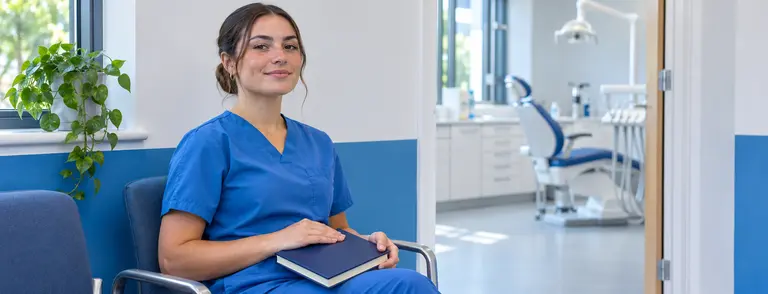
Most trainee dental nurses who stumble on exam day don’t stumble because they know too little. They stumble because a surprise laptop update, a mistyped password or a racing heartbeat got there before their knowledge could. That is why real dental nursing exam preparation starts long before you open a textbook, and why the calmest candidates are rarely the ones who revised the most. They are the ones who removed every avoidable problem in advance, so that on the day, the only thing left to do was think.
This guide walks you through the whole process from scratch: the technology, the rules, the day itself and the way of thinking that turns nerves into clear answers. No prior knowledge needed.
First, a Quick Map of the Territory
If you’re brand new, a few names will keep coming up:
- NEBDN (the National Examining Board for Dental Nurses) sets and marks the exams that lead to your dental nursing qualification.
- The GDC (General Dental Council) is the UK regulator. Passing your qualification is what allows you to apply to join its register and work as a registered dental nurse.
- MaxExam is the secure app NEBDN uses for online exams. Think of it as a locked exam hall that lives on your laptop.
Learners who registered from July 2025 onwards sit the NEBDN Level 3 Diploma, which is assessed through a portfolio of workplace evidence, an online multiple-choice Knowledge Test and an online Professional Discussion with an NEBDN examiner (a structured conversation about how you think and work). Learners on the older National Diploma route have a written exam and a practical exam instead. Your learner information pack tells you exactly which assessments, dates and times apply to you, so treat it as your single source of truth. If you’re still deciding on a route in, our NEBDN Level 3 Dental Nursing Course explains how training and assessment fit together.
Imagine Everything Going Wrong, Then Prevent It
Elite thinkers use a trick called inversion: instead of asking “How do I succeed?”, they ask “What would guarantee failure?” and then avoid those things. It is exactly how a good dental nurse thinks about cross-infection. You don’t hope instruments are clean; you picture how contamination could happen and close each route before it opens.
Apply that to exam day. What could sink you before you answer a single question?
- The laptop restarts for an update. Run all software updates in the days before, not the morning of.
- The battery dies. Keep your laptop plugged into power for the whole exam.
- The app won’t open. Use the same device you used for your preparation session. The app stays on your desktop after the practice run, so you only download it once.
- You can’t log in. Find the email from assessmentandawards@nebdn.org with your exam ID, user ID and password, and check it before the day.
- Your device isn’t up to the job. Work through NEBDN’s hardware guidelines and the Computer Health Check well ahead of time.
Your Pre-Exam Checklist
- Download the MaxExam app using NEBDN’s app download instructions.
- Complete the tutorial during your preparation session.
- Run the Computer Health Check and install any updates.
- Locate your login email and your start time.
- Choose your exam spot and plan your outfit.
Notice that none of these involve revision. That is the point. A small handful of practical tasks removes most of the things that derail candidates, which leaves your energy free for the questions themselves. This is the Pareto principle at work: roughly 20% of the effort prevents 80% of the problems.
Setting the Stage: Where You Sit and What You Wear
You can sit your online exam at home or at work, as long as the space is quiet, clear and free from interruptions. Tell housemates or colleagues when you’ll be unavailable, and clear the desk of notes and books.
For the Professional Discussion, NEBDN asks for smart casual clothing, the kind of outfit you would wear to a job interview. Don’t wear your clinical uniform. Dressing gowns, pyjamas and hoodies that hide your face are not acceptable.
Why does clothing matter in an online exam? Because the examiner is assessing a future professional. How you present yourself is part of the message you send about how seriously you take your patients.
Logging In Without the Panic
On exam day, double-click the MaxExam icon on your desktop. The login page opens automatically. Your details are in your NEBDN email, and all three are case sensitive, which means a capital letter in the wrong place counts as a different password, just like a bank login.
If your details don’t work, slow down and retype them carefully, character by character. If they still fail after several attempts, contact the examinations team at assessmentandawards@nebdn.org.
You don’t need to repeat the tutorial, but you can revisit it any time up to 30 minutes before your exam starts. After you begin the exam, the tutorial is no longer available, so do any refreshing beforehand.
When Technology Wobbles Mid-Exam
Here is a reassuring truth: NEBDN has planned for the most common hiccups.
If you lose your internet connection, keep going. You need a connection at the start and the end, but your answers are recorded in the app while you work, and connections usually return on their own within minutes. If you can’t submit at the end and see an “Assessment Error” message, click Retry once. If that fails, click Exit, reconnect your internet and log back in. The app will submit your assessment automatically.
If your laptop shuts down, plug in your charger, let any updates finish, then log back into MaxExam and carry on. If the laptop doesn’t come back on within five minutes, call the NEBDN Assessment and Awards team on 01772 429917. A dedicated team is available on that number during the exam.
A Script for Your Own Head
When something goes wrong, say this quietly to yourself:
“This has happened to others before. There’s a process. Step one: stay calm. Step two: follow the instructions. Step three: call the helpline if I need to.”
Clinical emergencies are handled the same way. Dental teams rehearse protocols so that under pressure they don’t have to invent a plan; they simply follow one.
Finding the Signal in Every Question
Exam questions often contain more detail than you need. Learning to separate signal (the information that actually decides the answer) from noise (the detail that just sets the scene) is one of the most valuable skills you can build, both in exams and in surgery.
NEBDN’s own advice gives you a simple framework you can use on every question:
- Read the question and decide what it is actually asking. Is it asking you to name, explain, compare or describe what you would do?
- Make brief notes. You’re allowed a pen and paper during the exam for this.
- Run the scenario in your head. How would you handle this if it happened in the surgery tomorrow?
- Talk yourself through it calmly. Put what you pictured into words.
- Take a moment to organise your thoughts. A short pause is not a weakness; it’s how careful professionals work.
Step three is quietly powerful. When you picture a real patient, a real instrument tray or a real conversation, you stop reciting memorised lists and start reasoning. Examiners can tell the difference, particularly in the Professional Discussion.
Watching the Clock and Finishing Cleanly
Once you click START, a countdown timer appears in the bottom right-hand corner of the screen. Glance at it at regular intervals rather than constantly.
When you’re ready to submit, click the MENU button at the bottom centre of the screen, then select FINISH EXAM, the top option. That’s it.
Why a Shortcut Could Cost You a Career
NEBDN uses invigilation software (a digital exam supervisor) that monitors your activity online and through your webcam, during both practice sessions and live exams. It flags irregular behaviour such as:
- having another person in the room or showing them the questions
- using pre-prepared notes or reference material
- covering the webcam
- sharing exam questions or answers on social media
Now apply second-order thinking, which means asking “And then what happens?” The first consequence of a shortcut might look small: one answer you didn’t have to work out. The second and third consequences are not small. NEBDN has withheld results, opened formal investigations and disqualified candidates, and some cases have gone to fitness to practise proceedings (the GDC’s process for deciding whether someone is safe to work with patients). Any of these could stop you becoming a dental nurse.
Honesty in the exam is the same honesty patients rely on every day. The General Dental Council’s Standards for the Dental Team make clear that trust sits at the heart of the profession, and your exam is the first place you show it.
The Examiner Is Not Your Opponent
This is the mindset shift that changes everything. Examiners don’t want you to fail. Their job is to give an independent judgement of your knowledge, understanding and competence. Every one of them has sat an assessment themselves, and they remember the nerves.
Try a regret minimisation check the night before. Picture yourself a year from now. Which version of today would you regret? Almost certainly the one where you rushed, panicked or second-guessed what you knew, not the one where you took a breath and explained calmly what you’ve learned. So give yourself permission to slow down.
Beyond the Exam: The Skills That Keep Growing
The habits you build preparing for this exam (anticipating risks, following protocols, filtering out noise, staying calm under pressure) are the same habits that grow a career. They’ll serve you in post-registration qualifications such as Oral Health Education, Dental Radiography and Fluoride Varnish Application, where you take on more responsibility and make more decisions on your own.
Quick-Action Summary
- Use the same device as your preparation session and keep it plugged in.
- Install updates and run the Computer Health Check days before.
- Have your case-sensitive login details ready.
- Wear smart casual, not uniform, for the Professional Discussion.
- If the internet drops, keep answering. If the laptop won’t restart within five minutes, call 01772 429917.
- Read, note, picture, explain, pause.
- Finish via MENU, then FINISH EXAM.
- Check NEBDN’s Diploma in Dental Nursing resources page for the latest official guidance.
Your Next Step Starts Here
Every confident registered dental nurse once sat exactly where you are now, wondering whether they were ready. Good dental nursing exam preparation is not about being fearless. It’s about being prepared enough that fear has nothing to grab onto.
Are you ready to step into your potential and transform your career? Your journey can start today: Apply Now – School of Dental Nursing Application Form.
Have questions, or would you like to talk things through first? Our experienced advisors are happy to help you work out the right path for you: Book a Call with an Advisor.