0208 993 4500
 dental@schoolofdentalnursing.com
 +44 7856 755880
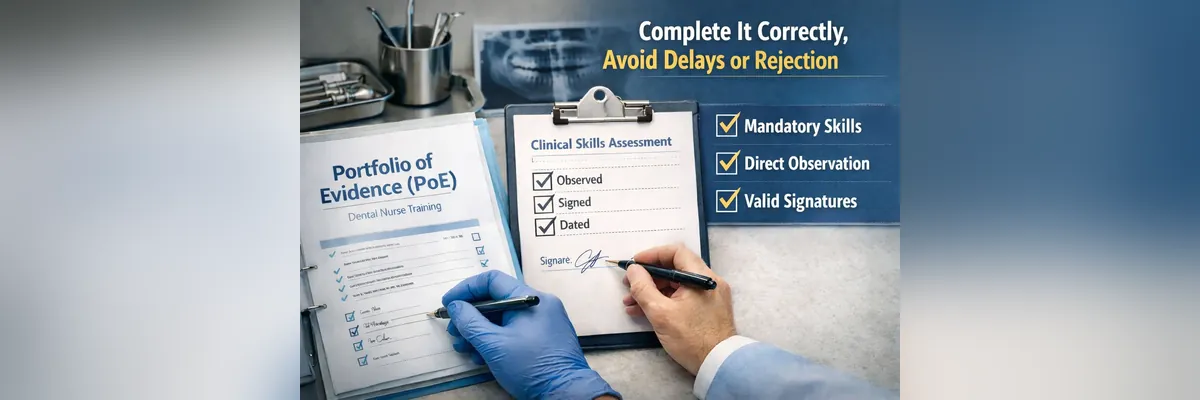
You can be calm, capable and trusted by every dentist in your practice and still be held back from qualifying. The cause usually isn’t what you can do. It’s what you can prove. That proof lives in one place: your dental nursing Portfolio of Evidence.
Most trainees see the portfolio as admin. That view causes delays. Once you see it as the record that shows you’re safe to work with patients, it gets easier to fill in, and you’re far less likely to have it sent back.
What Is a Dental Nursing Portfolio of Evidence?
A Portfolio of Evidence (PoE) works like a pilot’s logbook. A pilot can’t just say they’ve flown 500 hours. Every flight is written down, dated and checked. Your portfolio does the same for your clinical skills.
On the NEBDN Level 3 Diploma in Dental Nursing (RQF), the qualification for learners registered from 1 July 2025, you’re assessed in three ways:
- Portfolio of Evidence, which proves your skills in the real workplace
- Knowledge Test: 65 multiple-choice questions in 90 minutes
- Professional Discussion: a 60-minute online conversation with an assessor about your role and the work you do
You need a pass in all three. The Professional Discussion comes last, and you can only sit it once your portfolio and Knowledge Test are passed. A weak portfolio therefore delays everything that comes after it.
A few more facts are worth knowing early:
- You complete it online on a platform called PebblePad.
- Your training provider assesses it, and NEBDN (the National Examining Board for Dental Nurses, the awarding body) checks providers’ assessments through external moderation.
- It must be assessed over at least six months, because it’s designed to show how your skills develop over time.
If you’re studying our NEBDN Level 3 Dental Nursing Course, your tutor will guide you through each section. You can also read the official overview on the NEBDN Level 3 Diploma in Dental Nursing page.
Started on the older National Diploma? Your workplace portfolio is called the Record of Experience (RoE). The habits in this guide apply to it just as much.
What Counts as Evidence?
Evidence isn’t limited to signatures on forms. NEBDN accepts a range of types, including:
- Assessor observation, where your assessor watches you work
- Witness testimony, where a registered colleague confirms what they saw you do (this is mandatory for some criteria)
- Work products, such as documents, screenshots or photographs
- Personal statements, written or recorded as audio
- Video of you carrying out a task
- Training and appraisal records
- Feedback from colleagues or patients
One firm rule: no patient-identifiable information, such as names, faces or anything else that could reveal who someone is, unless the patient has given written consent.
How Would Your Portfolio Fail? Start There
Elite thinkers often solve problems backwards. Instead of asking “How do I pass?”, they ask “What would make this fail?” and then make sure those things don’t happen. This is called inversion, and it works very well for portfolios.
These problems most often send portfolios back:
- Work that isn’t yours. NEBDN states that all submitted work must be the learner’s own. Copying from a friend, a template or an AI tool can be treated as malpractice.
- Missing or invalid sign-offs. A witness or assessor who isn’t eligible, or a signature that isn’t there.
- Skills claimed without observation. If nobody saw it, it’s hard to prove.
- Dates that don’t make sense. Long gaps, entries completed all at once, or anything that looks backdated.
- Entries that don’t match your workplace. For example, writing about implant surgery when your practice doesn’t offer implants.
- Last-minute rushing. Rushing creates every one of the problems above.
Quick action: Read that list once a month and ask yourself honestly, “Is any of this true for me right now?”
Why Little and Often Beats All at Once
Cramming your portfolio in the final weeks looks efficient, but it causes problems later. Second-order thinking means asking “And then what?” before you act.
- First-order effect: You save time now by leaving entries until later.
- Second-order effect: You forget details, your entries turn vague, witnesses struggle to remember what they saw, and a sudden pile of entries with matching dates raises questions about authenticity.
Small entries made often add up. Fifteen minutes a week builds a portfolio that shows real progress, which is exactly what the six-month minimum is designed to capture.
A simple weekly routine:
- Friday, 15 minutes: Note two or three procedures you supported this week.
- Same day: Ask for any witness testimony while the memory is fresh.
- Once a month: Check your progress against the criteria you still need.
Write Entries That Sound Like You, Because They Are You
Assessors read many portfolios. Generic entries stand out for the wrong reasons. Think of it as signal versus noise: the signal is what you did, why you did it and what you learned. Everything else is noise.
Weak entry:
“Assisted with fillings as required.”
Strong entry:
“Assisted the dentist with a composite (tooth-coloured) filling on a lower back tooth. I set out the bonding agent and composite, kept the area dry using the aspirator, and passed instruments when asked. The patient was nervous, so I explained each step before it happened, and they told me afterwards that this helped.”
The strong entry is specific and personal, and it contains no patient-identifiable details. It also shows patient communication, a skill assessors want to see alongside clinical tasks such as cross-infection control, which means stopping germs from spreading between people, instruments and surfaces.
Rule of thumb: If a classmate could paste your entry into their portfolio unchanged, rewrite it.
Who Can Witness or Assess Your Portfolio?
This is one of the most misunderstood parts of the process, so here are the facts.
Witnesses observe you directly at work and confirm you’re competent. A witness must:
- Be a dentist, dental nurse or other dental care professional (such as a hygienist or therapist) with current GDC registration
- Be competent in the area they’re witnessing
NEBDN also recommends that a witness has worked with you on at least two occasions before.
Assessors judge your evidence formally. They must be GDC-registered and hold a recognised assessor qualification, or be working towards one under a qualified colleague who countersigns their decisions.
NEBDN also recommends that you have a workplace mentor: a GDC-registered colleague who supports your day-to-day progress.
A script for asking a witness:
“Could you watch me set up for this afternoon’s extraction? If you’re happy with what you see, would you be able to complete my witness testimony today while it’s fresh?”
The request is clear and specific, and asking on the day makes it easy for them to say yes.
Your Five-Minute Pre-Submission Check
Before you submit, go through this list:
- Every required criterion has evidence
- Dates run in a logical order, and nothing is backdated
- Every witness is GDC-registered and eligible
- No patient-identifiable information appears without written consent
- Every word is your own
- No section is left blank
If your portfolio isn’t accepted, you’ll usually be asked to correct and resubmit it. That delays your Professional Discussion, and in turn your registration. Concerns about authenticity can lead to a malpractice investigation. Five minutes of checking is far cheaper.
The Bigger Lesson Hidden in Your Portfolio
Accurate, honest record-keeping is one of the habits that defines a registered professional, and the GDC Standards for the Dental Team expect it of everyone on the register. The discipline you build now (recording promptly, writing specifically, inviting scrutiny) is the same discipline you’ll use for patient records, continuing professional development and any post-registration dental nursing courses you take later.
Your portfolio isn’t just a hurdle before your exams. It’s your first professional record, and it shows that you’re safe, competent and ready.
Ready to Take Your Next Step?
Are you ready to step into your potential and start building a career you can be proud of? At the School of Dental Nursing, you’ll get structured guidance, assessor support and portfolio checks at every stage, so you’re never left guessing.
👉 Apply Now – School of Dental Nursing Application Form
Still have questions, or would you like to talk things through first? Our experienced advisors are happy to help you work out the right route for you.