0208 993 4500
 dental@schoolofdentalnursing.com
 +44 7856 755880
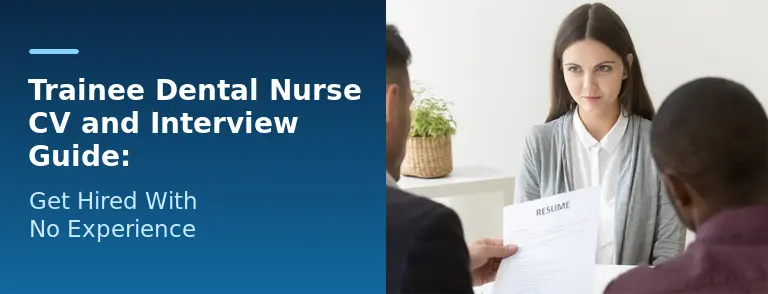
Here’s what most first-time applicants get wrong: they think a practice manager is looking for experience. For a trainee role, they’re mostly looking for evidence that you’ll be safe, reliable and easy to teach. That changes everything about how you write a trainee dental nurse CV and how you answer interview questions. You don’t need a dental background. You need to show, with real examples, that you have the qualities that make a great dental nurse.
This guide walks you through it from scratch: a CV that gets read, a cover letter you can adapt in minutes, and an interview plan that helps you walk in calm and walk out with an offer.
First, Understand Who’s Reading Your Application
A good way to start is a thinking tool called inversion: instead of asking “How do I impress them?”, ask “Why would a practice manager reject my application in ten seconds?” Usually it’s because the CV:
- Is generic and clearly sent to fifty practices
- Is long, cluttered and hard to scan
- Makes claims (“hard-working team player”) with no proof
- Has spelling mistakes, which worry someone hiring for a job where accuracy matters
Fix those four things and you’re already ahead of most applicants.
How to Write a Trainee Dental Nurse CV That Gets Read
Practice managers are busy. Think of your CV as a shop window: they’ll glance for a few seconds, and only come inside if something catches their eye. That’s signal versus noise. Everything that shows you’d suit dental nursing is signal. Everything else is noise, so cut it.
Keep it to one or two pages, in this order:
- Contact details: name, phone number, email and town. You don’t need your full address, date of birth or a photo.
- Personal profile: three or four lines saying who you are, what role you want and what you bring.
- Education and training: including any dental nursing course you’ve enrolled on or applied for.
- Work experience: most recent first, with one or two achievements for each role.
- Skills: the ones that matter in a surgery (see below).
- References: “Available on request” is fine.
Turn Any Job Into Dental-Relevant Experience
You probably have more relevant experience than you think. Retail, hospitality, care work and volunteering all build skills a dental practice values. The trick is to translate them:
| Instead of writing… | Try writing… |
| “Worked on a till” | “Handled cash accurately and kept careful records during busy shifts” |
| “Waitress” | “Stayed calm and polite with customers under time pressure” |
| “Helped my nan” | “Supported an elderly relative with appointments and daily care” |
Tailor the Top Third Every Time
Here’s the Pareto Principle in action: a small part of your CV does most of the work. The personal profile at the top is what gets read. Rewrite those few lines for each practice, mentioning something specific about them. It takes five minutes and makes a generic CV feel personal.
Need a starting point? Download our free CV Template and adapt it.
A Cover Letter You Can Adapt in Minutes
A short, polite email or letter can open doors, even when no job is advertised. Copy this and fill in the brackets:
Dear [Practice Manager’s name, or “Sir or Madam” if you can’t find it],
I’m writing to ask whether you have, or may soon have, a Trainee Dental Nurse position at [Practice name].
I [have enrolled on / am applying for] the NEBDN Level 3 Diploma in Dental Nursing with the School of Dental Nursing. I’m now looking for a practice where I can gain hands-on experience and build my Portfolio of Evidence while I train.
[One sentence about why this practice: for example, its reputation for family dentistry or its location.] I’ve attached my CV, which shows my experience in [your strongest relevant skill].
If there’s nothing suitable right now, I’d be grateful if you could keep my details on file for future roles.
Thank you for your time.
Yours sincerely,
[Full name] | [Phone number] | [Email]
Why speculative letters work: many trainee roles are filled before they’re ever advertised. A clear, polite letter that lands at the right moment can beat a crowded job board.
How to Answer “Why Should We Hire You?”
This is the question most trainees dread, and most answer badly. Generic replies like “I’m a hard worker with great communication skills” sound like everyone else. A better approach is a simple three-part structure:
- Quality: name one strength that matters in dentistry.
- Proof: give a short, real example.
- Link: connect it to the role.
Example answer:
“I’m calm and caring with people who are anxious. In my job at [workplace], I often dealt with upset customers, and I learned to listen first and stay patient. I know many dental patients feel nervous, so I think that would help me support both patients and the dentist from day one. I’m also really keen to learn, which is why I’ve already [enrolled on / applied for] my dental nursing diploma.”
Notice that every claim has evidence behind it. A claim without an example is noise. An example is the signal.
Five Questions to Practise Before Any Interview
Prepare a short answer for each, using real examples:
- Tell me about yourself. Keep it to around a minute: where you are now, what led you to dental nursing, and where you want to go.
- Why do you want to work with us? Research the practice first. Mention something specific.
- Why did you choose this career? An honest personal reason beats a rehearsed one.
- Where do you see yourself in five years? Qualified and registered, perhaps adding a post-registration skill such as Oral Health Education or dental radiography.
- What makes you suitable for this role? Use the Quality, Proof, Link structure.
Bonus tip: prepare two questions to ask them, such as “How do you support trainees with their course?” or “What would a typical day look like?” It shows genuine interest.
The Three Qualities Every Practice Looks For
- Communication: spoken and unspoken. Patients notice your tone, eye contact and body language as much as your words.
- Adaptability: a dental surgery changes minute by minute. Show you can adjust to new situations and learn quickly.
- Attention to detail: in dentistry, small details protect patients. Mention a time when accuracy mattered in your work.
For each one, have a real example ready.
Show You Understand the Profession
You’ll stand out if you show you know what the job really involves. Dental nurses work within the General Dental Council’s Standards for the Dental Team, which put patients’ interests first. Mentioning that you’ve read them shows maturity.
It also helps to know how you’ll qualify. The NEBDN Level 3 Diploma in Dental Nursing is assessed through a Portfolio of Evidence, an online Knowledge Test and a Professional Discussion. Many practices will also ask about your Hepatitis B vaccination status and arrange a DBS (criminal record) check, so have that information ready.
Before You Hit Send: Your Trainee Dental Nurse CV Checklist
- CV is one or two pages and free of spelling mistakes
- Personal profile is rewritten for this practice
- Every skill has an example behind it
- Cover letter is addressed to a named person where possible
- You’ve researched the practice before the interview
- You’ve practised your answers aloud, not just in your head
Your Next Step Starts Here
The hardest part of any career change is starting. If you’re unsure whether to apply, ask yourself which you’d regret more in a year: sending an application that didn’t work out, or never trying at all. At the School of Dental Nursing, we’ve helped trainees take that first step since 2006, with our Online Diploma in Dental Nursing, on-campus classes in West London, and a personal tutor beside you all the way.
Ready to step into your potential and transform your career? Your journey can start today: Apply Now – School of Dental Nursing Application Form
Got questions, or want to talk it through with an expert educator first? We’d love to hear from you: Book a Call with an Advisor