0208 993 4500
 dental@schoolofdentalnursing.com
 +44 7856 755880

Most people think a dental nurse’s job is to pass instruments. That’s a bit like saying a pilot’s job is to press buttons. It’s technically true, and it completely misses the point.
So what does a dental nurse do, really? In short: you keep patients safe, calm and cared for, while helping the dentist work quickly and accurately. The instruments are the visible part. The real skill is invisible: noticing, anticipating, protecting and thinking one step ahead. This guide shows you both, starting from absolute scratch.
What Does a Dental Nurse Do? The Quick Answer
A dental nurse is a registered member of the dental team who:
- Prepares the surgery (the treatment room) before each patient
- Supports the dentist during check-ups, fillings, extractions and more complex treatments
- Looks after the patient, especially anyone nervous, in pain or needing extra support
- Prevents infection by cleaning, sterilising and following strict safety procedures
- Keeps accurate records of what happened during each appointment
A Day in the Surgery, Hour by Hour
Every practice is different, but a typical day might look like this:
- 8:15am — Set-up. You switch on equipment, run safety checks and lay out what the first appointments need.
- 9:00am — First patients. A routine check-up, then a filling. You greet each patient, settle them in the chair and support the dentist.
- Between every patient. You clean the treatment area, take used instruments for decontamination and reset the room. This happens dozens of times a day.
- Midday. Perhaps an extraction (a tooth removal) or a root canal treatment, which needs more preparation and focus.
- Afternoon. Children, older patients, nervous patients. Each needs something slightly different from you.
- 5:30pm — Close-down. Final cleaning, restocking and checks, so tomorrow starts safely.
That’s the timetable. Here’s what makes someone genuinely excellent at it.
Reading the Patient Before They Say a Word
Many patients arrive nervous: worried about pain, embarrassed, or anxious after years away.
Great dental nurses learn to separate signal from noise. In a busy surgery there is a lot of noise: the suction, the dentist’s requests, the next patient waiting. The signal is the small things that matter: a gripped armrest, a held breath, a patient who has suddenly gone quiet.
When you spot that signal, you act on it. A simple script you can use:
“You’re doing really well. If you need us to stop at any point, just raise your left hand and we’ll pause straight away.”
That one sentence gives a frightened person back a sense of control. And if you notice someone becoming uncomfortable during treatment, you let the dentist know calmly. Empathy here isn’t a “nice extra”. It’s part of safe care.
Thinking One Step Ahead of the Dentist
During treatment, the dentist and nurse work as a pair, often called four-handed dentistry: two people, four hands, one smooth flow of work.
Beginners wait to be asked for things. Experienced nurses anticipate. They know a filling follows a predictable sequence, so the next material is ready before anyone asks for it.
This is called second-order thinking: asking not just “what’s happening now?” but “and then what?” If the dentist is about to finish drilling, then they’ll need the filling material, then the curing light, then the patient will need to rinse. See the chain, and you’ll always be ready.
You don’t need every procedure on day one. You learn the patterns, and anticipation follows.
The Invisible Work That Keeps Everyone Safe
A huge part of dental nursing is infection prevention. In plain terms, that means stopping germs travelling from one person to another, which is called cross-infection.
Think of a kitchen: chop raw chicken, then slice salad on the same unwashed board, and someone could get ill. A dental surgery works on the same principle, with much stricter rules.
Elite nurses use a habit called inversion. Instead of asking “how do I do this right?”, they ask: “How could someone get hurt here?” Then they remove each risk:
- A used instrument mixed up with a clean one? Follow a strict clean-to-dirty workflow.
- Splashes during treatment? Wear the correct protective equipment: gloves, mask, eye protection.
- A sharp item left out? Dispose of it immediately and safely.
Patients rarely notice this work. That’s exactly the point.
Why Good Record-Keeping Is a Quiet Superpower
Records can feel like paperwork, but think ahead: months later, another dentist may need to know which material was used or whether a patient reacted to something. Your clear notes protect that patient’s future care. And everything you learn about a patient stays confidential.
Knowing Exactly Where Your Role Ends
Every dental professional works within a scope of practice: the list of tasks you’re trained and allowed to do. Think of it like a driving licence. A car licence doesn’t let you drive a bus, however confident you feel.
The General Dental Council Scope of Practice guidance sets this out. Knowing your boundaries isn’t a weakness. It’s a mark of professionalism, and asking “Can I check that with you before I go ahead?” is always the right call when you’re unsure.
Where a Dental Nursing Career Can Take You
Qualifying isn’t the finish line. Once registered, many nurses add post-registration skills, such as:
- Oral health education — teaching patients how to look after their teeth and gums. See our Oral Health Education course.
- Dental radiography — taking dental X-rays. You’ll learn the principle of ALARP, “as low as reasonably practicable”: using only the radiation that’s truly needed, like using just enough light to read by rather than every lamp in the house. Explore our Dental Radiography course.
- Fluoride varnish application — applying a protective coating to teeth, on a dentist’s prescription.
Others move into orthodontics, oral surgery, sedation, teaching or practice management.
Is Dental Nursing Hard?
Honestly? It can be. You’re on your feet, juggling tasks and supporting frightened people. The good news: you don’t need to master everything at once.
The Pareto principle says roughly 80% of results come from 20% of efforts. In your first months, a few habits make most of the difference:
- Follow infection-control steps exactly, every time.
- Watch the patient, not just the procedure.
- Ask questions whenever you’re unsure.
How Do You Become a Dental Nurse in the UK?
Dental nursing is a regulated profession. Only people registered with the General Dental Council (GDC) can legally call themselves a “dental nurse”, so while you train, your title is trainee dental nurse.
The most common route looks like this:
- Get a job as a trainee dental nurse in a dental practice.
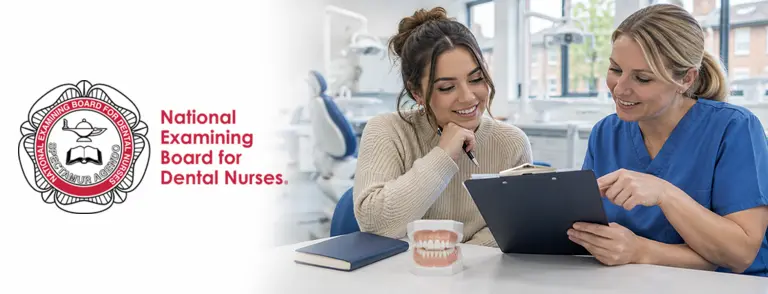
- Enrol with an NEBDN-accredited training provider. From 1 June 2026, the GDC requires new trainees to start a recognised training programme within 12 months of starting work.
- Study for a recognised qualification, such as the NEBDN Level 3 Diploma in Dental Nursing. You build a portfolio of evidence from your real workplace alongside NEBDN’s formal assessments.
- Apply to join the GDC register once you’ve qualified.
Apprenticeships are another route, and you can often study online while you work.
Could This Be the Right Path for You?
Here’s a simple test called regret minimisation. Imagine yourself five years from now. Will you regret trying dental nursing, or regret never finding out whether it was for you?
Then ask yourself three quick questions:
- Do I genuinely care about people feeling safe?
- Do I enjoy practical, hands-on work?
- Am I willing to keep learning?
Three yeses? Then you already have the foundations. Everything else can be taught.
Quick-Action Summary
- Watch for signals of anxiety and give patients control.
- Think one step ahead of the dentist.
- Ask “how could someone get hurt?” to prevent infection and errors.
- Know your scope of practice, and ask when unsure.
- Keep growing through post-registration skills.
Your Next Step Starts Here
You now know what a dental nurse actually does, and the hidden skills that make the great ones stand out.
Are you ready to step into your potential and transform your career? Take the first step today: Apply Now – School of Dental Nursing Application Form.
Still have questions, or want to talk it through with an expert educator first? We’d love to help: Book a Call with an Advisor.